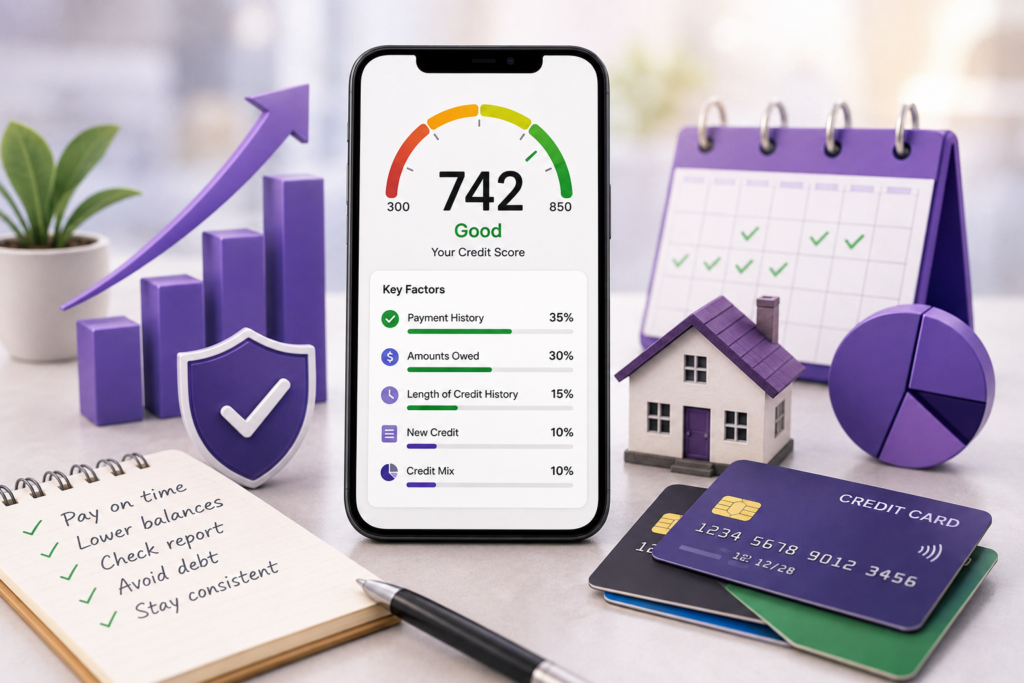
How to improve credit score is one of the most searched personal finance questions in the United States—and for good reason. Whether you’re preparing to apply for a credit card, auto loan, mortgage, or simply want better financial opportunities, improving your credit score can make a real difference.
Short on time? Listen to this AI-generated audio summary covering the key strategies discussed in this guide.
The good news is that you can improve your credit score faster than many people think—but only if you focus on the strategies that actually influence your score. Many common tips shared online are outdated, misleading, or have little impact.
In this guide, you’ll discover 7 proven strategies that can help improve your credit score legally and responsibly. You’ll also learn how long improvements typically take, which credit habits matter most, and the mistakes that can slow your progress.
If you apply these strategies consistently, many people begin seeing positive changes within 30 to 90 days, although results vary depending on your credit history and financial situation.
Before learning how to improve your credit score fast, it’s important to understand what a credit score actually is.
A credit score is a three-digit number that helps lenders estimate how likely you are to repay borrowed money on time. In the United States, credit scores typically range from 300 to 850, with higher scores indicating lower credit risk.
Your credit score plays an important role whenever you apply for financial products such as a credit card, personal loan, auto loan, or mortgage. In many cases, it can also influence the interest rate you’re offered, the credit limit you receive, and even whether your application is approved.
A higher credit score doesn’t just improve your chances of getting approved—it can also save you thousands of dollars in interest over the life of a loan.
The good news is that your credit score isn’t permanent. By building healthy credit habits and avoiding common mistakes, you can gradually improve your score over time.
How to Improve Credit Score Fast?
If you’re wondering how to improve your credit score fast, the first thing to know is that there are no legal shortcuts or overnight fixes.
Credit scores improve when lenders and credit bureaus see consistent, responsible financial behavior over time. but the right actions can produce noticeable results sooner than many people expect.
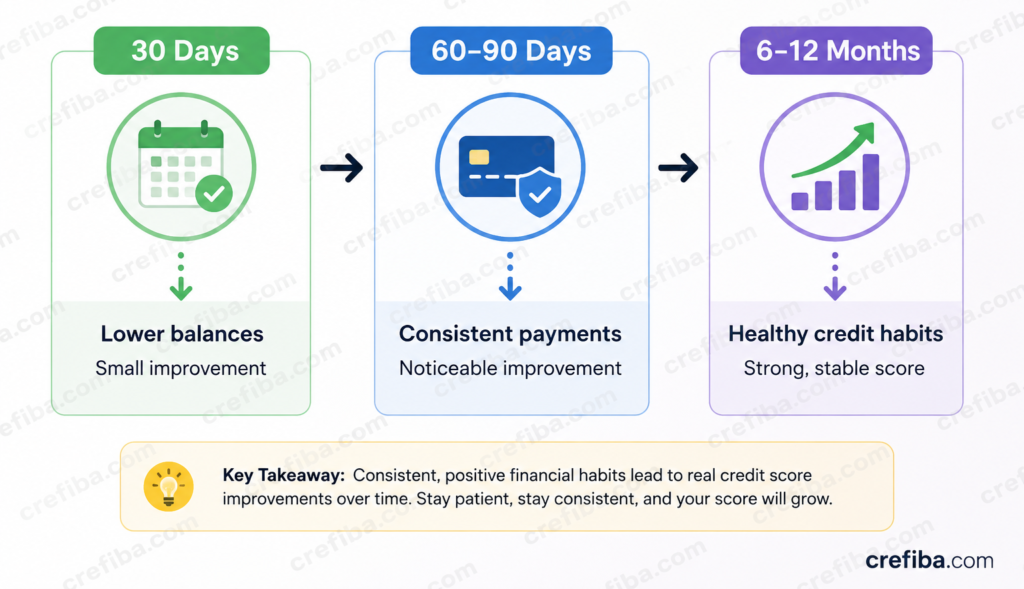
The timeline depends on factors such as your payment history, credit utilization, existing debt, and the information being reported to the credit bureaus. While every situation is different, here’s what many people experience after adopting healthier credit habits:
How Long Does It Take to Improve Your Credit Score?
There’s no fixed timeline for improving a credit score because every credit profile is different. While some people notice positive changes within a few weeks, others may need several months before seeing significant improvement.
The speed of improvement depends on what’s affecting your credit score today and how consistently you practice healthy credit habits. Understanding the factors below will help you set realistic expectations and focus on what matters most.
Timeline
What You Can Expect
Within 30 days
You may begin to see small improvements after paying down credit card balances or correcting reporting errors.
Within 60–90 days
Consistent on-time payments and lower credit utilization can lead to more noticeable score improvements.
Within 6–12 months
Responsible credit habits often result in stronger, more stable credit score growth.
Why Do Two People Improve at Different Speeds?
Two people can follow the exact same credit improvement plan and still see different results. That’s because their credit reports, financial history, and current credit habits are rarely identical.
For example, someone with high credit card balances may see faster improvements after paying down debt, while another person recovering from missed payments or collections may need more time because negative information remains on their credit report longer. Your starting point plays a major role in how quickly your score can improve.
What Factors Make Credit Score Improvement Faster or Slower?
Several factors influence how quickly your credit score changes.
You may see faster improvement if you:
Lower your credit card balances.
Make every payment on time.
Correct errors on your credit report.
Avoid applying for unnecessary new credit.
On the other hand, improvement may take longer if you have recent late payments, high debt, multiple hard inquiries, or a very short credit history. Building excellent credit is a gradual process that rewards consistent financial behavior.
Which Credit Score Factors Update Monthly and Which Take Years?
Not all credit score factors change at the same pace.
Some information, such as your credit card balances and monthly payment history, is typically updated each billing cycle. This means responsible credit use can begin affecting your score relatively quickly.
Other factors, such as the length of your credit history and older negative marks, improve much more slowly because they depend on time. Keeping older accounts open and maintaining positive payment history helps strengthen your credit profile over the long term.
Why Does One Person Gain 30 Points While Another Gains Only 5?
The number of points your credit score increases depends on what changed and how important that factor is within your credit profile.
For example, reducing credit utilization from 90% to 20% may result in a noticeable improvement for one person. Another individual who already has low balances but a history of late payments may see only a small increase because payment history carries significant weight in most credit scoring models.
Instead of comparing your progress with someone else’s, focus on building consistent credit habits. Over time, steady improvements are far more valuable than chasing quick point increases.
Timeline
What You Can Expect
Within 30 days
You may begin to see small improvements after paying down credit card balances or correcting reporting errors.
Within 60–90 days
Consistent on-time payments and lower credit utilization can lead to more noticeable score improvements.
Within 6–12 months
Responsible credit habits often result in stronger, more stable credit score growth.
The key is consistency. Credit scores reward long-term responsible behavior—not quick fixes or shortcuts.
Real-Life Example
Imagine two people who both have a credit score of 620.
Person A continues making only minimum payments while keeping credit card balances close to their limits.
Person B pays every bill on time, reduces credit card balances below 30% of the available limit, and avoids applying for unnecessary new credit.
After several months, Person B is much more likely to see meaningful credit score improvement because their credit report reflects lower risk to lenders.
This is exactly how credit scoring models are designed to work—they respond to positive financial behavior over time.
How To Improve Your Credit Score In 30 Days?
Many people hope to improve their credit score in just 30 days, especially before applying for a credit card, auto loan, or mortgage. While a dramatic increase is uncommon, it is possible to see meaningful improvement within a month if you focus on the factors that have the biggest impact on your credit score.
The fastest improvements usually come from paying down high credit card balances, bringing overdue accounts current, and correcting any errors on your credit report. These actions can reduce your credit utilization and ensure your credit file accurately reflects your financial behavior.
What you can’t do in 30 days is erase years of missed payments or instantly build a long credit history. Those factors require time and consistent responsible credit use.
If your goal is to improve your credit score within 30 days, focus on these priorities:
Pay your credit card balances below 30% of the available credit limit.
Make every payment on or before the due date.
Review your credit reports for errors and dispute inaccurate information.
Avoid applying for unnecessary new credit, as multiple hard inquiries can temporarily affect your score.
Continue monitoring your credit progress using trusted credit monitoring services.
Small improvements today can become significant gains when these habits are maintained over the following months.
8 Proven Strategies That Actually Work
Improving your credit score isn’t about finding a secret trick—it’s about following proven financial habits consistently. The eight strategies below are based on how major U.S. credit scoring models, including FICO, evaluate your creditworthiness. Whether you’re building credit for the first time or trying to recover from past mistakes, these practical steps can help you strengthen your credit profile over time.
1.Pay Every Bill on Time (Payment History – Approximately 35% of Your FICO Score)
★★★★★ Highest Impact Approximate Weight:35% of your FICO® Score Results: Medium to Long Term Difficulty: ⭐ Easy
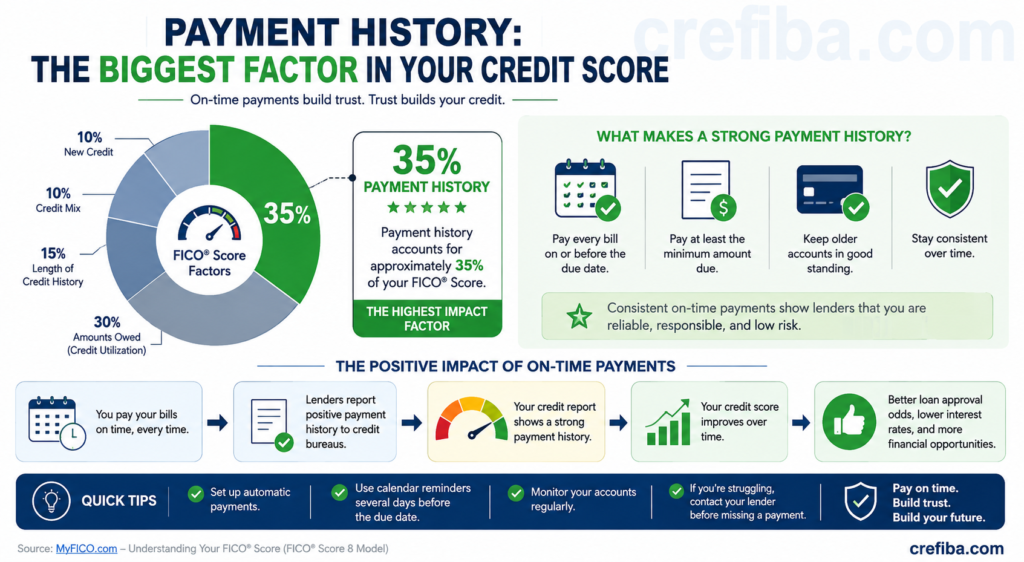
If you’re looking for the fastest and most reliable way to improve your credit score, start by paying every bill on time. Among all the factors used to calculate a FICO Score, payment history carries the greatest weight, accounting for approximately 35% of your score.
Every on-time payment tells lenders that you’re a responsible borrower who can manage debt consistently. Over time, this builds trust and strengthens your credit profile. On the other hand, missed or late payments can remain on your credit report for years and may significantly reduce your score, particularly if they become 30 days or more past due.
Unlike some credit score factors that take years to improve, payment history begins building with every billing cycle. While one on-time payment won’t dramatically increase your score overnight, consistently paying every account on time creates a strong foundation for long-term credit health.
Why Payment History Is So Important
When lenders review your credit report, their biggest concern isn’t how much money you earn—it’s whether you’ve demonstrated a consistent habit of repaying borrowed money.
Your payment history includes:
Credit card payments
Auto loans
Personal loans
Student loans
Mortgages
Other reported credit accounts
The more consistently you pay these accounts on time, the more confidence lenders have in your ability to repay future debt.
Practical Ways to Never Miss a Payment
Building an excellent payment history doesn’t require complicated strategies. Small habits can make a big difference over time.
Set up automatic payments
Enable AutoPay for at least the minimum payment due. This reduces the risk of forgetting a payment because of a busy schedule or travel.
Use payment reminders
Set reminders on your phone or calendar a few days before each due date so you have time to verify your account balance before payment is processed.
Pay more than the minimum whenever possible
Although paying the minimum protects your payment history, paying more also helps reduce your credit utilization and interest costs over time.
Contact your lender if you’re facing financial hardship
If you think you’ll miss a payment, contact your lender before the due date. Some lenders offer temporary hardship programs that may help you avoid delinquency.
What Happens If You Miss a Payment?
Not every late payment immediately affects your credit score, but waiting too long can have serious consequences.
Payment Status
Possible Impact
1–29 days late
You may incur a late fee. Many lenders don’t report the payment to the credit bureaus until it becomes significantly overdue, but policies vary by lender.
30+ days late
The late payment may be reported to the credit bureaus and can negatively affect your credit score.
60–90+ days late
Continued delinquency can have a more significant impact on your credit profile and make future borrowing more difficult.
Common Mistakes to Avoid
Many people unintentionally hurt their credit score by making avoidable mistakes.
Avoid these common habits:
Assuming one late payment “won’t matter.”
Ignoring payment reminders.
Paying bills after the due date every month.
Missing payments while focusing on paying off only one debt.
Forgetting small credit card accounts that are rarely used.
Consistency—not perfection—is what helps build excellent credit over time.
Pro Tip– If you’re managing multiple credit cards or loans, consider aligning your payment due dates with your payday. Many lenders allow you to request a different due date, making it easier to manage your monthly cash flow and avoid missed payments.
If you’ve been making every payment on time but your credit score still isn’t improving, another factor—such as credit utilization or hard inquiries—may be limiting your progress.
Key Takeaway– No single strategy has a greater impact on your credit score than consistently paying every bill on time. If you can only focus on one habit, make it this one. A strong payment history builds trust with lenders, protects your credit profile, and lays the foundation for every other credit improvement strategy discussed in this guide.
2.Lower Your Credit Utilization Below 30% (Credit Utilization – Approximately 30% of Your FICO Score)
★★★★★ Very High Impact Approximate Weight:30% of your FICO Score Results: Fast (Often Within the Next Reporting Cycle) Difficulty: ⭐⭐ Easy to Moderate
If you’re wondering how to improve your credit score fast, lowering your credit utilization ratio is often one of the quickest strategies that can produce measurable results.
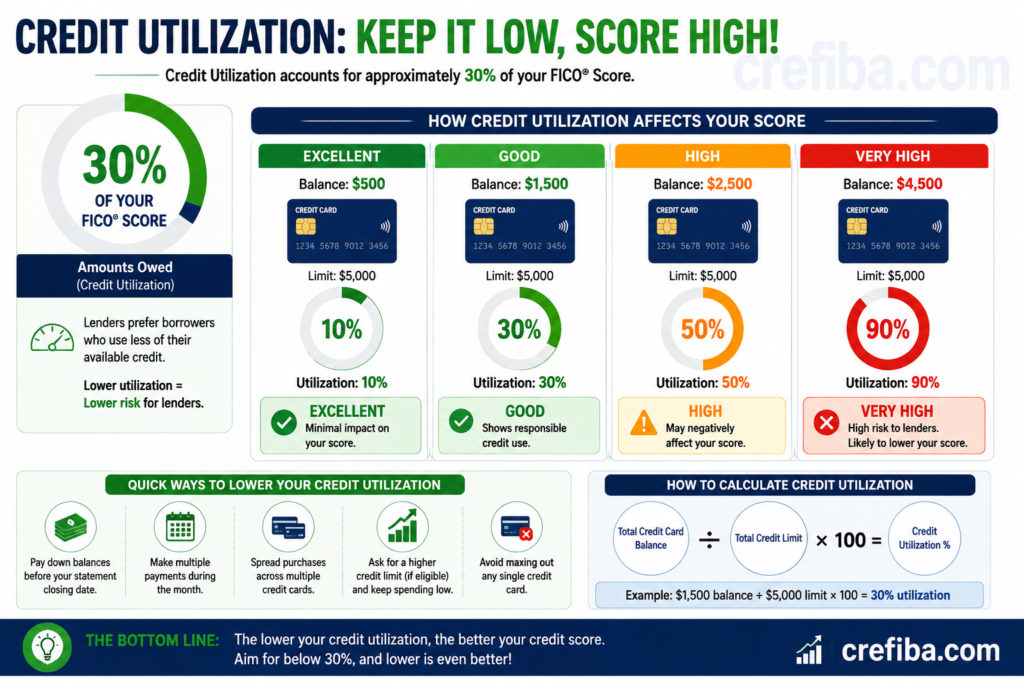
Credit utilization refers to how much of your available revolving credit you’re currently using. It is the second most influential factor in calculating a FICO® Score, accounting for approximately 30% of your score.
In simple terms, lenders prefer borrowers who use credit responsibly rather than relying heavily on it. A lower utilization ratio suggests that you’re managing your available credit wisely and are less likely to be overextended financially.
What Is Credit Utilization?
Your credit utilization ratio is calculated by dividing your total credit card balance by your total available credit limit.
Even if you pay your bills on time every month, consistently carrying high balances can reduce your credit score because it signals increased borrowing risk.
What Is the Ideal Credit Utilization Ratio?
There isn’t an official minimum percentage required for a good credit score, but many financial experts recommend keeping your utilization below 30%.
However, lower is generally better.
Credit Utilization
General Impact
0–10%
⭐ Excellent
10–30%
✅ Good
30–50%
⚠ Fair
Above 50%
❌ May significantly affect your score
Remember, this is a guideline—not a rule. Maintaining low utilization consistently is more important than hitting an exact number.
Practical Ways to Lower Your Credit Utilization
The good news is that improving your utilization ratio doesn’t always require earning more money or opening new accounts.
Here are some effective strategies:
Pay down your credit card balances as much as possible before your statement closing date.
Make multiple payments during the month instead of waiting until the due date.
Avoid maxing out any single credit card, even if your overall utilization is low.
Spread purchases across multiple credit cards if you have more than one account.
Request a higher credit limit from your card issuer if your income and payment history support it—but avoid increasing your spending just because your limit increases.
Common Mistakes to Avoid
Many people unknowingly keep their utilization high by making these mistakes:
Paying only the minimum amount due each month.
Waiting until the payment due date instead of the statement closing date.
Maxing out one credit card while leaving others unused.
Closing old credit cards, which reduces your total available credit and may increase your utilization percentage.
Pro Tip– Even if you pay your credit card balance in full every month, your issuer may report your balance before your payment is made.
To keep your reported utilization lower, consider paying down a portion of your balance before the statement closing date, not just before the payment due date.
If your credit score dropped recently even though you’ve never missed a payment, high credit utilization may be the reason.
Key Takeaway– Lowering your credit utilization is one of the fastest legitimate ways to improve your credit score. Keeping your balances low—ideally below 30%, and even lower whenever possible—shows lenders that you’re using credit responsibly without depending heavily on borrowed money.
3.Check Your Credit Report and Dispute Errors (Credit Report Accuracy – Can Have a Significant Impact)
★★★★☆ High Impact FICO Weight: No fixed percentage (Affects multiple scoring factors) Results: Fast if inaccurate information is corrected Difficulty: ⭐⭐ Easy
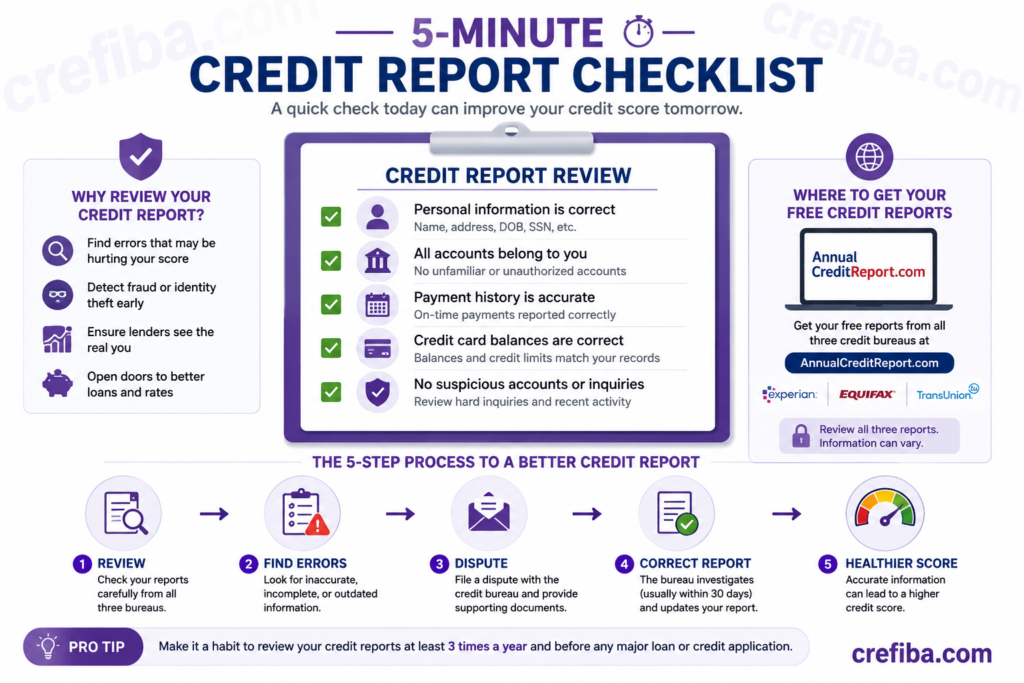
One of the most overlooked ways to improve your credit score is simply making sure your credit report is accurate.
Your credit score is calculated using the information contained in your credit reports. If that information is incorrect—such as a payment mistakenly marked late, an account that doesn’t belong to you, or an inaccurate balance—your score could be lower than it should be.
Unlike payment history or credit age, you don’t have to wait months to benefit from correcting an error. Once a legitimate error is investigated and updated, your credit score may improve when the corrected information is reflected in your credit file.
Why Checking Your Credit Report Matters
Credit reports are prepared by the three major U.S. credit bureaus:
Experian
Equifax
TransUnion
Although they collect similar information, each bureau may receive slightly different data from lenders. That’s why it’s important to review reports from all three whenever possible.
Regularly checking your credit report can help you:
Identify reporting errors.
Spot fraudulent or unauthorized accounts.
Verify that payments are being reported correctly.
Confirm balances and credit limits are accurate.
Detect identity theft early.
Even a small reporting mistake can affect your ability to qualify for a loan, mortgage, or credit card.
Common Credit Report Errors
Watch for issues such as:
Possible Error
Why It Matters
Incorrect personal information
May indicate a mixed credit file.
Accounts that don’t belong to you
Could be identity theft or reporting errors.
Incorrect late payments
May unfairly lower your credit score.
Wrong account balances
Can increase your reported credit utilization.
Closed accounts reported as open (or vice versa)
May affect your credit profile.
Duplicate accounts
Can make your debt appear higher than it actually is.
If you notice any inaccurate information, gather supporting documents before filing a dispute.
How to Dispute an Error on Your Credit Report
If you believe information on your credit report is incorrect, you can usually dispute it directly with the credit bureau reporting the error.
The general process is straightforward:
Review your credit report carefully.
Identify the inaccurate information.
Collect supporting documents, if available.
Submit a dispute with the appropriate credit bureau.
Monitor the status of your dispute and review the updated report once the investigation is complete.
Providing clear documentation can help speed up the investigation.
Where Can You Check Your Credit Report?
The only official website authorized to provide free credit reports from the three nationwide credit bureaus is:
Reviewing your reports regularly helps ensure the information used to calculate your credit score is accurate and up to date.
Common Mistakes to Avoid
Avoid these common errors when reviewing your credit report:
Assuming your credit report is always correct.
Ignoring unfamiliar accounts or inquiries.
Filing disputes for accurate information simply because it negatively affects your score.
Checking only one credit bureau instead of reviewing all available reports.
Remember, only inaccurate information should be disputed. Accurate negative information generally remains on your credit report for the period allowed under applicable laws.
Pro Tip– Make it a habit to review your credit reports several times a year, especially before applying for a mortgage, auto loan, or new credit card. Finding and resolving issues early can prevent unnecessary delays during the approval process.
Key Takeaway– Your credit score is only as accurate as the information in your credit report. Regularly reviewing your reports and correcting legitimate errors can protect your credit profile, improve your borrowing opportunities, and help ensure you’re not being penalized for inaccurate information.
4. Avoid Unnecessary Hard Credit Inquiries (New Credit – Approximately 10% of Your FICO® Score)
★★★☆☆ Moderate Impact Approximate Weight:10% of your FICO Score Results: Short to Medium Term Difficulty: ⭐⭐ Easy
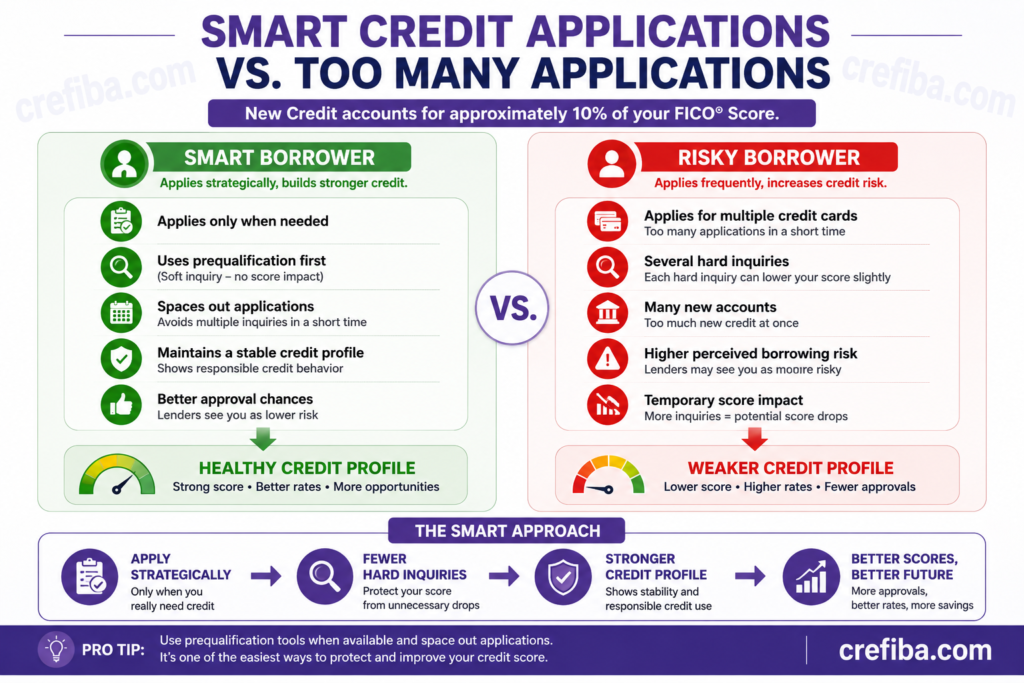
Every time you apply for a new credit card, personal loan, auto loan, or mortgage, the lender may perform a hard credit inquiry to evaluate your creditworthiness.
While a single hard inquiry usually has only a small effect on your credit score, multiple applications within a short period can signal increased borrowing risk to lenders. That’s why the FICO® Score considers your recent credit activity when calculating your score.
If your goal is to improve your credit score fast, it’s generally a good idea to avoid applying for credit unless you genuinely need it.
Why Hard Inquiries Matter
Opening several new credit accounts in a short period can make it appear that you’re relying heavily on borrowed money.
Although one hard inquiry may reduce your score by only a few points—or in some cases have little noticeable impact—multiple inquiries combined with new accounts can affect your overall credit profile.
This is especially important if you’re planning to apply for a:
Mortgage
Auto loan
Personal loan
Premium rewards credit card
Maintaining a stable credit profile before applying can improve your chances of approval and help you qualify for better interest rates.
When a Hard Inquiry Is Worth It
Not every hard inquiry should be avoided.
Applying for credit makes sense when you:
Need financing for a home or vehicle.
Want to refinance an existing loan.
Need a credit card that better fits your financial goals.
Are building credit responsibly.
The key is to apply strategically, not frequently.
Practical Tips to Reduce Hard Inquiries
Here are a few ways to keep unnecessary hard inquiries to a minimum:
Compare eligibility requirements before submitting an application.
Avoid applying for multiple credit cards just to receive welcome bonuses.
Space out new credit applications whenever possible.
Use prequalification or preapproval tools when available, as many use soft inquiries instead of hard inquiries.
Apply only when you genuinely need additional credit.
These simple habits can help protect your credit score while still allowing you to access credit when it’s appropriate.
Does Rate Shopping Hurt Your Credit Score?
If you’re shopping for the best interest rate on a mortgage, auto loan, or certain student loans, multiple hard inquiries made within a limited period are generally treated as a single inquiry by many FICO® scoring models.
This allows consumers to compare loan offers without being heavily penalized for responsible rate shopping.
However, this treatment doesn’t usually apply to applying for several different credit cards.
Common Mistakes to Avoid
Avoid these habits if you’re trying to improve your credit score:
Applying for several credit cards in the same month.
Opening new accounts just because you’ve been pre-approved.
Financing purchases you don’t actually need.
Ignoring the impact of frequent credit applications before applying for a major loan.
Responsible borrowing is more valuable than simply having more credit accounts.
Pro Tip– If you’re planning to apply for a mortgage or auto loan within the next few months, try to avoid opening new credit accounts beforehand. A stable credit profile often puts you in a stronger position during the approval process.
Wondering whether checking your own credit score affects your credit?
That guide explains the difference between soft inquiries and hard inquiries, and why checking your own credit score is completely safe.
Key Takeaway– A single hard inquiry is rarely a major problem, but repeatedly applying for new credit can slow your credit-building progress. Apply for credit only when it supports your financial goals, and whenever possible, use prequalification tools to understand your options before submitting a formal application.
5. Keep Older Credit Accounts Open (Length of Credit History – Approximately 15% of Your FICO Score)
★★★★☆ High Impact Approximate Weight:15% of your FICO Score Results: Long Term Difficulty: ⭐⭐ Easy
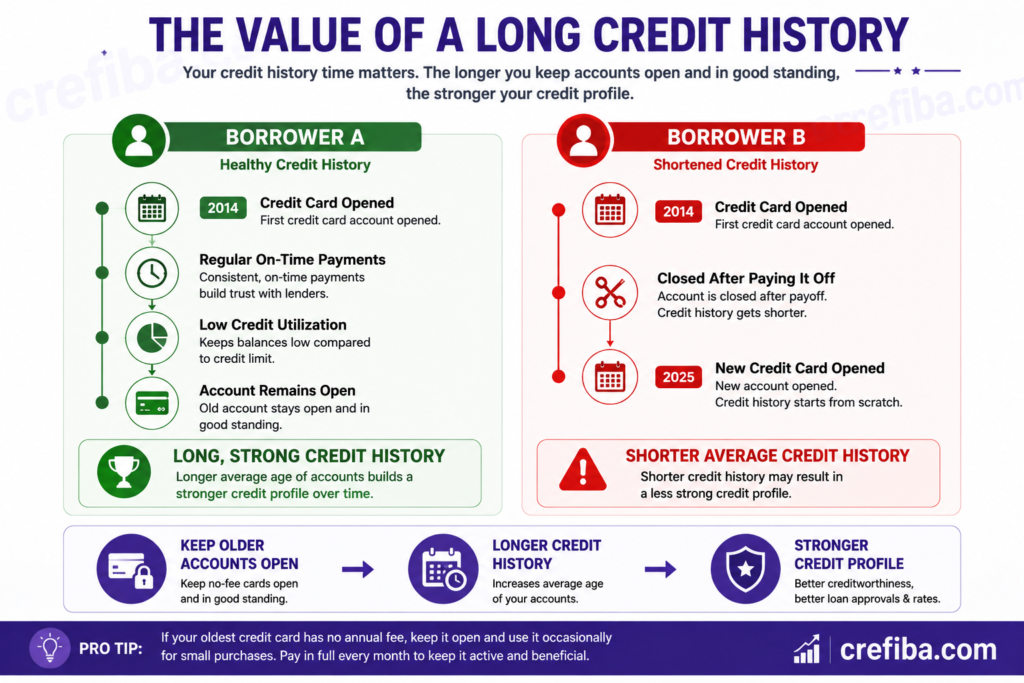
Many people believe closing an old credit card is a smart financial decision once they’ve paid it off. While that may seem logical, closing your oldest credit accounts can sometimes work against your credit score.
The length of your credit history accounts for approximately 15% of a FICO® Score. In general, lenders prefer borrowers who have demonstrated responsible credit management over many years rather than those with only a short credit history.
The longer you’ve successfully managed credit accounts, the more information lenders have to evaluate your borrowing habits.
Why Does Credit History Matter?
Your credit history helps lenders understand how you’ve managed credit over time—not just today.
FICO considers several aspects of your credit history, including:
The age of your oldest credit account.
The average age of all your accounts.
How long specific accounts have been open.
How long you’ve been actively using credit.
A longer and well-managed credit history generally indicates greater financial stability and responsible borrowing behavior.
Does Closing an Old Credit Card Hurt Your Credit Score?
It can.
When you close an older credit card, you may reduce your total available credit, which could increase your credit utilization ratio. In addition, over time, losing older accounts may reduce the average age of your credit history.
For this reason, many financial experts recommend keeping your oldest credit card open if:
It has no annual fee.
You can manage it responsibly.
You don’t have a compelling reason to close the account.
Keeping older accounts active can strengthen your overall credit profile.
When Closing an Account Makes Sense
Keeping every account forever isn’t always the right decision.
You may consider closing an account if:
The annual fee no longer provides enough value.
The account has been compromised by fraud.
You’re simplifying your finances and understand the potential impact.
The lender closes the account at your request after discussing available options.
Before closing any long-standing account, consider how it may affect both your credit utilization and your overall credit history.
Simple Example
Imagine two borrowers applying for the same auto loan.
Borrower
Credit History
Sarah
Has responsibly used the same credit card for 12 years.
James
Opened his first credit card only 18 months ago.
Even if both have similar credit scores today, lenders may view Sarah’s longer credit history as additional evidence of consistent and responsible credit management.
Common Mistakes to Avoid
Avoid these common errors that may shorten your effective credit history:
Closing your oldest credit card immediately after paying it off.
Opening several new credit cards within a short period.
Ignoring inactive older accounts until they’re automatically closed.
Cancelling a no-fee card simply because you rarely use it.
Sometimes, making a small purchase every few months and paying it off in full is enough to keep an older account active.
Pro Tip– If your oldest credit card has no annual fee, consider keeping it open and using it occasionally for a small recurring expense—such as a streaming subscription or utility bill—and pay the balance in full each month. This helps keep the account active while continuing to build your credit history.
to learn how paying off debt affects your credit utilization and overall credit health.
Key Takeaway– Time is one of the few credit score factors you can’t speed up. Keeping older credit accounts open, maintaining them responsibly, and avoiding unnecessary closures can strengthen your credit history and contribute to a healthier credit score over the long term.
6. Become an Authorized User on a Well-Managed Credit Card (Can Help Build Credit Faster)
★★★☆☆ Moderate Impact FICO Weight: No fixed percentage (Can positively influence multiple scoring factors) Results: Medium Term (Varies by issuer and credit bureau reporting) Difficulty: ⭐⭐ Easy
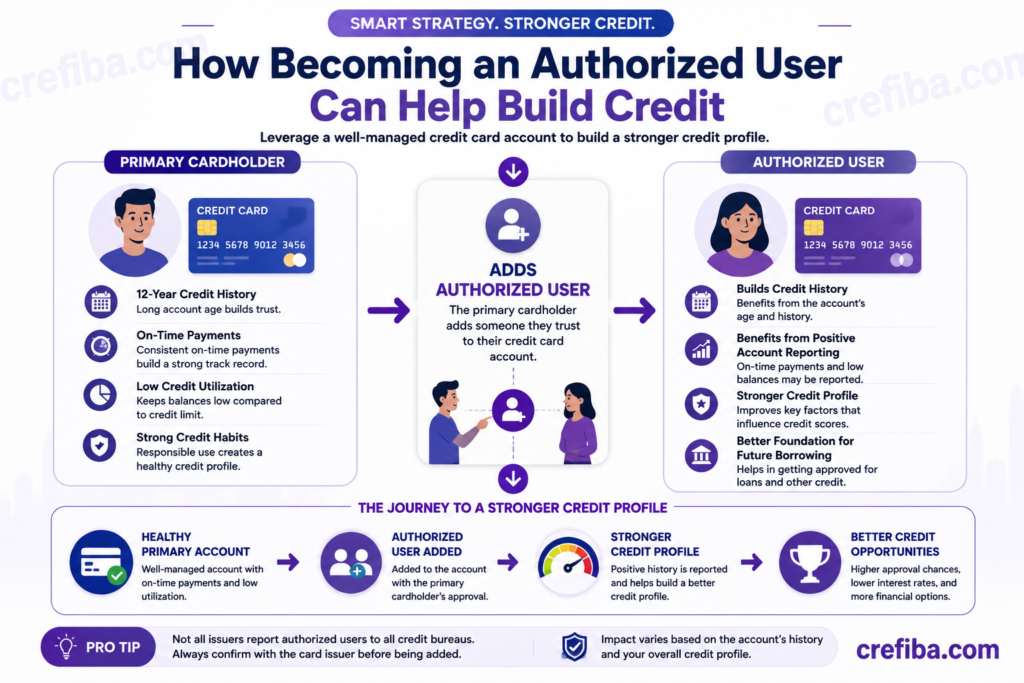
If you’re new to credit or have a limited credit history, becoming an authorized user on someone else’s well-managed credit card account may help strengthen your credit profile.
An authorized user is someone who is added to another person’s credit card account with permission from the primary cardholder. Depending on the card issuer and how the account is reported, the account’s payment history, age, and credit limit may appear on the authorized user’s credit report.
This can be especially helpful for young adults, students, or anyone beginning their credit journey.
How Does Being an Authorized User Work?
When you’re added as an authorized user, the primary cardholder remains legally responsible for paying the bill.
You receive permission to use the card (if the primary cardholder chooses to give you access), but you are not responsible for repaying the debt.
If the account is reported to the credit bureaus, you may benefit from the account’s positive history, including:
Long payment history.
Low credit utilization.
Older account age.
Consistent on-time payments.
However, not every credit card issuer reports authorized user accounts to all three credit bureaus, so it’s worth confirming this before being added.
Who Should You Become an Authorized User With?
Choosing the right account is important.
Ideally, the primary cardholder should have:
A long history of on-time payments.
Low credit utilization.
An older credit card account.
Responsible spending habits.
No recent late payments.
Being added to an account with poor payment history or high balances could have the opposite effect and may not help your credit profile.
Simple Example
Imagine Emma has no credit history.
Her mother has had the same credit card for 12 years, has never missed a payment, and usually keeps the balance below 10% of the credit limit.
Emma is added as an authorized user.
If the issuer reports authorized user activity, Emma’s credit profile may benefit from that positive account history, giving her a stronger foundation as she begins building credit independently.
Common Mistakes to Avoid
Avoid these common mistakes before becoming an authorized user:
Joining an account with a history of missed payments.
Being added to a card that’s nearly maxed out.
Assuming every card issuer reports authorized users.
Depending entirely on someone else’s account instead of building your own credit over time.
An authorized user strategy works best when combined with your own responsible credit habits.
Pro Tip– Before asking someone to add you as an authorized user, ask two simple questions:
✔ Does the issuer report authorized users to the major credit bureaus?
✔ Does the account have a strong payment history and low credit utilization?
If the answer to both is yes, it could be a worthwhile credit-building strategy.
If you’re just starting your credit journey, you’ll also find these guides helpful:
Key Takeaway– Becoming an authorized user isn’t a shortcut to perfect credit, but it can be an effective way to strengthen your credit profile when you’re added to a well-managed account. The biggest benefits come from joining an account with a long history of on-time payments, low balances, and responsible credit management.
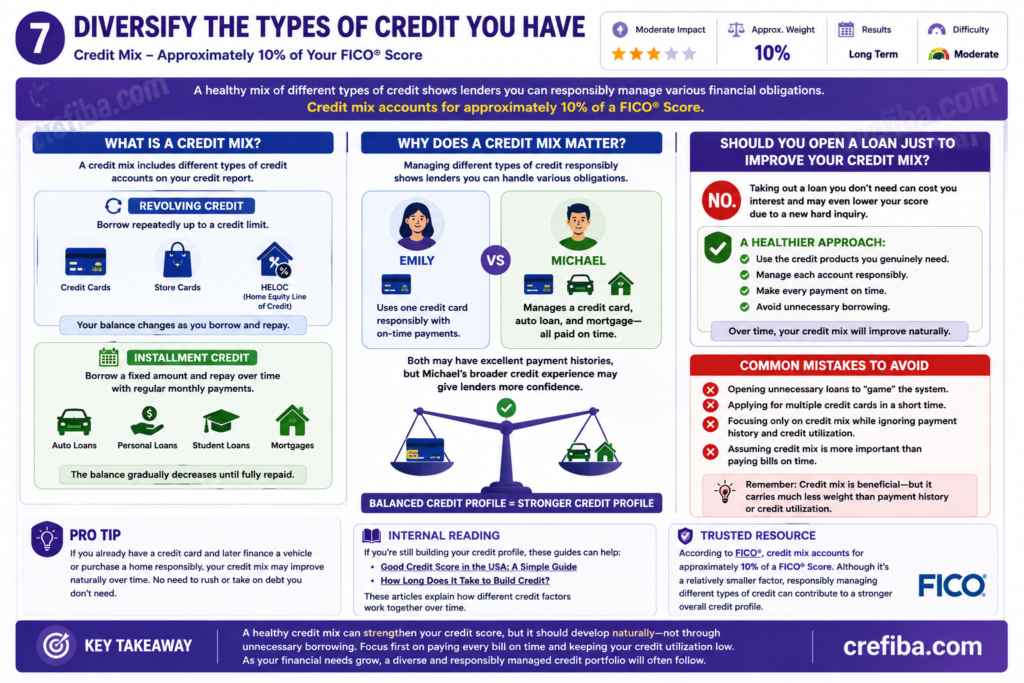
7. Diversify the Types of Credit You Have (Credit Mix – Approximately 10% of Your FICO Score)
★★★☆☆ Moderate Impact Approximate Weight:10% of your FICO Score Results: Long Term Difficulty: ⭐⭐⭐ Moderate
While paying your bills on time and keeping credit card balances low have the greatest impact on your credit score, having a healthy mix of different types of credit can also strengthen your credit profile over time.
This factor, known as credit mix, accounts for approximately 10% of a FICO Score.
Lenders like to see that you’ve successfully managed different types of credit—not just one. Responsible use of multiple credit products demonstrates that you can handle different borrowing responsibilities, whether it’s a credit card, an auto loan, or a mortgage.
That said, you should never borrow money simply to improve your credit score. A strong credit mix develops naturally as your financial needs evolve.
What Is a Credit Mix?
A credit mix is the combination of different types of credit accounts you have on your credit report, such as credit cards, auto loans, mortgages, student loans, and personal loans. Having a healthy mix of credit—and managing each account responsibly—can positively contribute to your credit score over time.
These generally fall into two categories:
Revolving Credit
These accounts allow you to borrow repeatedly up to a credit limit.
Examples include:
Credit cards
Store credit cards
Home equity lines of credit (HELOCs)
Your balance changes as you borrow and repay.
Installment Credit
These loans provide a fixed amount of money that you repay over a set period through regular monthly payments.
Examples include:
Auto loans
Personal loans
Student loans
Mortgages
Unlike revolving credit, the balance gradually decreases until the loan is fully repaid.
Why Does a Credit Mix Matter?
Managing different types of credit responsibly shows lenders that you can handle various financial obligations.
For example:
Borrower
Credit Profile
Emily
Uses one credit card responsibly with on-time payments.
Michael
Manages a credit card, auto loan, and mortgage—all paid on time.
Both borrowers may have excellent payment histories, but Michael’s broader experience managing different types of credit may provide lenders with additional confidence.
Should You Open a Loan Just to Improve Your Credit Mix?
No.
This is one of the biggest misconceptions about improving a credit score.
Taking out a loan you don’t need simply to diversify your credit accounts can cost you money through interest charges and may even lower your score temporarily because of a new hard inquiry.
A healthier approach is to:
Use the credit products you genuinely need.
Manage each account responsibly.
Make every payment on time.
Avoid unnecessary borrowing.
Over time, your credit mix will improve naturally.
Common Mistakes to Avoid
Many people unintentionally weaken their credit profile by:
Opening unnecessary loans to “game” the credit scoring system.
Applying for multiple credit cards within a short period.
Focusing only on credit mix while ignoring payment history and credit utilization.
Assuming a credit mix is more important than paying bills on time.
Remember, credit mix is beneficial—but it carries much less weight than payment history or credit utilization.
Pro Tip– If you already have a credit card and later finance a vehicle or purchase a home responsibly, your credit mix may improve naturally over time. There’s no need to rush the process or take on debt that doesn’t support your financial goals.
Key Takeaway– A healthy credit mix can strengthen your credit score, but it should develop naturally—not through unnecessary borrowing. Focus first on paying every bill on time and keeping your credit utilization low. As your financial needs grow, a diverse and responsibly managed credit portfolio will often follow.
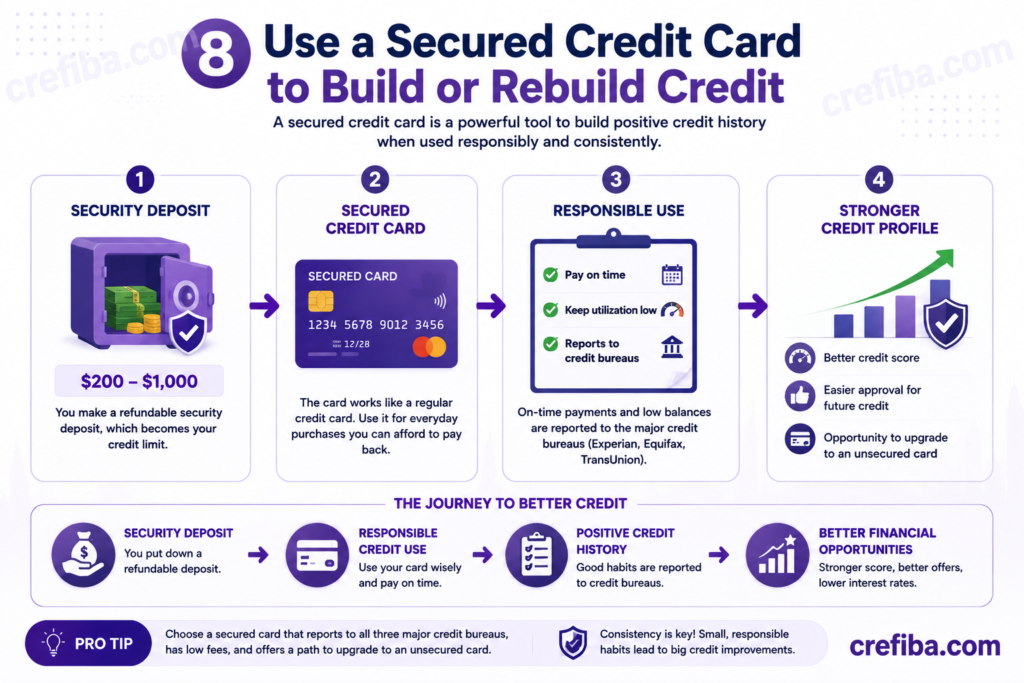
8. Use a Secured Credit Card to Build or Rebuild Credit
★★★★☆ High Impact FICO Weight: No fixed percentage (Can positively influence Payment History, Credit Utilization, and Length of Credit History) Results: Medium Term (Often Within 3–6 Months of Responsible Use) Difficulty: ⭐⭐ Easy
If you have little credit history, a low credit score, or you’re rebuilding your credit after financial difficulties, a secured credit card can be one of the most effective tools available.
Unlike a traditional credit card, a secured credit card requires a refundable security deposit. That deposit usually becomes your credit limit, reducing the lender’s risk while giving you the opportunity to demonstrate responsible credit use.
As long as the card issuer reports your account activity to the major U.S. credit bureaus, every on-time payment and every month of responsible use can help strengthen your credit profile.
What Is a Secured Credit Card?
A secured credit card works much like a regular credit card.
The biggest difference is that you provide a refundable security deposit when opening the account.
For example:
Security Deposit
Typical Credit Limit
$200
$200
$500
$500
$1,000
$1,000
You can use the card for everyday purchases, but it’s important to pay the balance on time and keep your credit utilization low.
Responsible use allows you to build a positive payment history, which is the most important factor in a FICO Score.
Who Should Consider a Secured Credit Card?
A secured credit card may be a good option if you:
Have no credit history.
Are rebuilding credit after missed payments or bankruptcy.
Have been denied a traditional credit card.
Want to establish responsible credit habits.
Many secured cards also allow you to upgrade to an unsecured credit card after demonstrating consistent responsible use.
How to Use a Secured Credit Card the Right Way
A secured card only helps if you use it responsibly.
Follow these best practices:
Use the card for small everyday purchases.
Keep your utilization below 30% of the credit limit.
Pay the full statement balance on time every month.
Avoid cash advances whenever possible.
Keep the account open to continue building your credit history.
Responsible habits matter far more than how much you spend.
Common Mistakes to Avoid
Avoid these common errors:
Maxing out your secured credit card.
Missing payment due dates.
Closing the account too soon after opening it.
Choosing a card that doesn’t report to all three major credit bureaus.
Paying unnecessary fees when better secured card options are available.
Always verify that the issuer reports your account activity to Experian, Equifax, and TransUnion before applying.
Pro Tip– When comparing secured credit cards, don’t choose one based solely on the lowest deposit requirement.
Instead, look for a card that:
Reports to all three major credit bureaus.
Has low or no annual fees.
Offers the opportunity to graduate to an unsecured credit card.
Provides free credit monitoring or educational tools.
These features can make your credit-building journey more effective.
Key Takeaway– A secured credit card isn’t a shortcut to excellent credit—but it can be an excellent starting point. When used responsibly, it helps you build positive payment history, maintain low credit utilization, and establish a stronger credit profile over time.
Frequently Asked Questions About Improving Credit Scores
Can I improve my credit score in 30 days?
Yes, small improvements are possible if you reduce utilization and fix recent negatives.
What’s the safe legal way to improve credit score fast?
Lowering balances and stopping late payments.
Does paying off debt instantly boost credit scores?
It helps, but results depend on utilization and reporting cycles.
Should I close paid-off credit cards?
Usually no — keeping them open helps your score.
Final Thoughts
Improving your credit score fast in the USA is about doing fewer things — but doing them correctly. Focus on reducing risk signals, stay consistent, and give the system time to recognize the change.
If this helped you, save it and share it with someone who’s trying to rebuild their credit. The right information at the right time can make a real difference.
The Crefiba Research Team creates easy-to-understand, accurate, and practical content on credit, personal finance, and banking in the United States. Our articles are carefully researched using trusted sources such as Experian, Equifax, TransUnion, and U.S. financial institutions, and are written to help everyday people make smarter financial decisions.