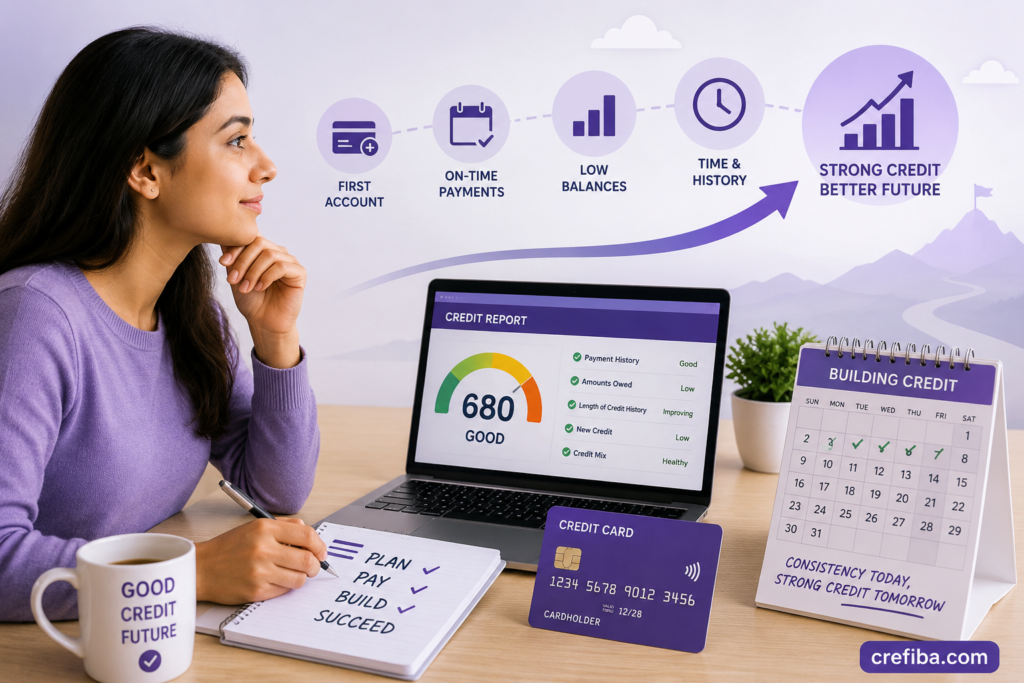
How long does it take to build credit? There isn’t one exact answer because your timeline depends on where you’re starting, the type of credit accounts you have, and how consistently you manage them.
If you have no credit history, you may be able to establish your first credit score within several months. But building a strong credit profile—and eventually reaching a good or excellent score—usually takes longer. If you’re rebuilding damaged credit, the timeline can vary even more depending on what is affecting your credit.
The good news is that you don’t have to wait years to see every positive change. Some improvements, such as lowering high credit card balances, can show up relatively quickly once updated information reaches the credit bureaus. Other factors, such as building a long credit history, naturally require more time.
In this guide, we’ll break down how long it takes to build credit from different every starting points, what you can realistically expect in the first 30 days, 6 months, 1 year, and beyond—and what you can do to build a stronger credit profile without taking unnecessary risks.
Quick answer: Building credit is a gradual process. You may establish a credit score within several months, but developing strong, well-established credit generally takes longer and requires consistent responsible credit management.
How Long Does It Take to Build Credit?
There is no single timeline for building credit because your starting point matters. Someone opening their first credit account is building credit from scratch, while someone with a history of late payments is rebuilding an existing credit profile.
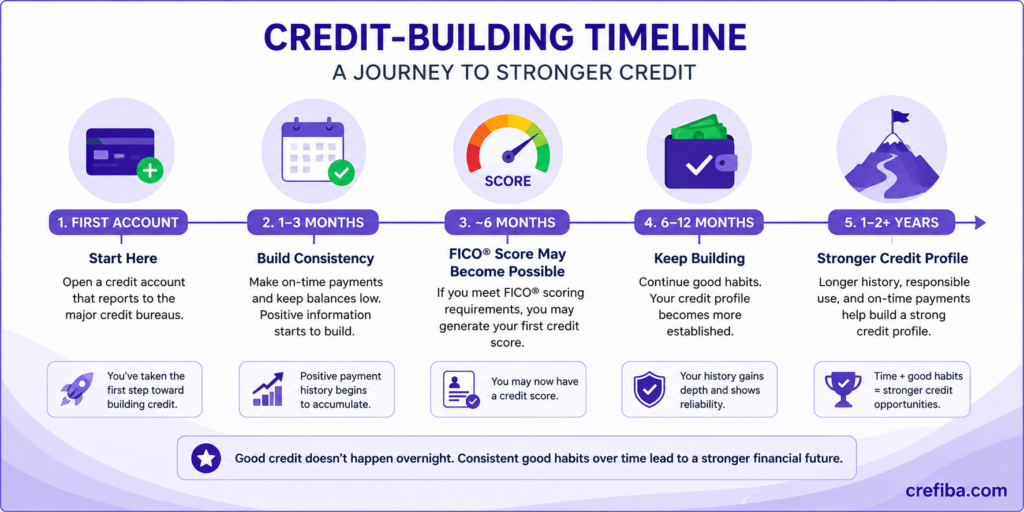
If you’re starting with no credit history, you may be able to establish a FICO Score after about six months, if your credit report meets FICO’s minimum scoring requirements: at least one account must have been open for six months or more, and at least one account must have reported to the credit bureau within the past six months.
However, getting your first credit score is not the same as building good credit. A score can exist while your credit history is still relatively short. Building a stronger profile requires more time and a consistent record of responsible credit management.
A practical way to think about the process is:
| Timeline | What May Be Happening |
|---|---|
| First 1–3 months | New accounts begin reporting; you start establishing payment history |
| Around 6 months | You may become eligible for a FICO Score if the requirements are met |
| 6–12 months | More payment history and account information accumulate |
| 1–2+ years | Your credit history becomes more established |
| Long term | Consistent payments, responsible utilization, and aging accounts can continue strengthening your profile |
These are general milestones, not guaranteed score increases. Your results can be faster or slower depending on your accounts, payment history, credit utilization, and any negative information already on your credit report.
If you’re looking to actively improve an existing credit score rather than establish credit from scratch, our guide on how to improve your credit score fast explains eight practical strategies you can use.
The most important distinction
Building a credit score can happen in months. Building strong credit takes longer.
If you’re rebuilding damaged credit rather than starting from zero, the timeline can be considerably different. The CFPB notes that rebuilding credit takes time and that there are no shortcuts; consistent on-time payments and responsible use are key.
So, if you’re wondering “How long will it take me?”, the next question should be:
Where are you starting from?
That’s why the rest of this guide breaks the timeline down for people with no credit, new credit, fair or poor credit, and negative marks on their credit reports.
Why Does Building Credit Take Time?
Building credit takes time because credit scores are based on your history of managing credit, not just what you are doing today. Credit reporting companies collect information about your accounts, payments, balances, and credit activity, and scoring models use that information to evaluate your creditworthiness.
Think of your credit profile like a financial track record. One on-time payment is a good start, but several months of consistent payments provide much more evidence that you can manage credit responsibly.
Your payment history needs to build
Payment history is the largest category in a typical FICO Score, accounting for 35%. Each month of on-time payments adds to your record, while missed or late payments can work against you.
Your accounts need to age
Length of credit history accounts for about 15% of a typical FICO Score. FICO considers factors such as the age of your oldest account, newest account, and the average age of your accounts. That means this part naturally takes time—you cannot create years of credit history overnight.
Your credit utilization can change sooner
Unlike account age, your credit utilization can change relatively quickly when your reported balances change. FICO considers amounts owed at roughly 30% of a typical score, so reducing a high balance can affect your score once the updated information is reported.
New credit can temporarily work against you
Opening several new accounts or applying for credit repeatedly in a short period can affect your score, particularly when your credit history is still young. FICO considers new credit as about 10% of a typical score.
The bottom line: some parts of your credit profile can change within weeks or months, while others—especially your credit history—need years to mature. That’s why building a credit score and building strong, established credit are two different goals.
How Long Does It Take to Get Your First Credit Score?
If you have no credit history, your first goal isn’t reaching a 700 or 800 score. It’s getting enough credit activity on your report for a scoring model to generate a score.
For a FICO Score, you generally need at least one account that has been open for six months or longer and at least one account reported to a credit bureau within the past six months. This means many people starting from scratch may need about six months before a FICO Score can be calculated.
However, this doesn’t mean your credit suddenly becomes “good” at six months.
First 1–3 months
Your new credit account may begin appearing on your credit reports. You’re starting to build payment history, but your credit file is still very young.
Around 6 months
If your credit history meets FICO’s requirements, you may now have enough information to receive a FICO Score.
After 6 months
Your score can continue changing as more payment history, balances, account age, and other credit information are reported.
What about VantageScore?
VantageScore can sometimes generate a score with a much shorter credit history than FICO. So you might see a credit score from one service before you are eligible for a FICO Score.
Important: Having your first credit score doesn’t mean you’ve built a strong credit profile. A young credit file can still limit your borrowing options even if the score itself looks good.
Think of six months as a possible starting point for a FICO Score—not a finish line for building credit.
How Long Does It Take to Build Credit From Scratch?
If you’re starting with no credit history, building credit is a gradual process. You first need a credit account that reports your activity, then you need to demonstrate responsible behavior consistently.
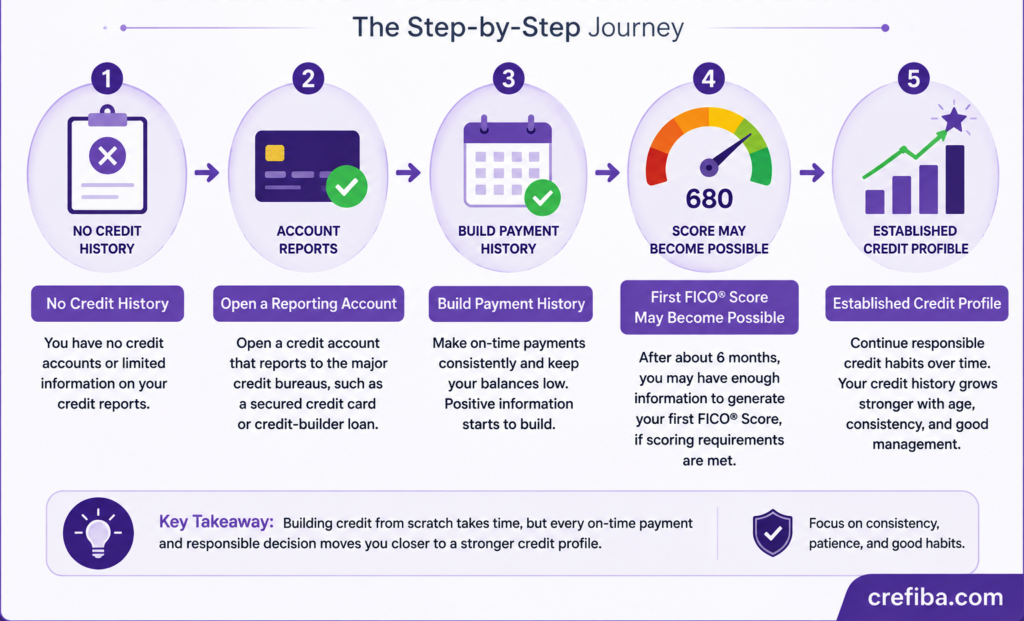
A realistic progression might look like this:
First 30 Days: Establish the Foundation
Once you open a credit account that reports to the major credit bureaus, your account may begin appearing on your credit reports.
At this stage, focus on the basics:
- Make every payment on time.
- Keep your balance low.
- Avoid applying for several new accounts.
- Check that your account is being reported correctly.
Don’t worry if you don’t have a score immediately. Credit reporting and credit scoring don’t happen instantly.
2–3 Months: Build a Payment Record
With each reporting cycle, you can begin accumulating more positive credit history.
This is where consistency matters. Even if your score hasn’t changed much, you’re building the underlying history that scoring models can evaluate.
Around 6 Months: Your First FICO Score May Become Possible
If you meet FICO’s minimum scoring requirements, you may now be eligible for a FICO Score.
But don’t expect a specific score simply because you’ve reached six months. Your score depends on the information in your credit report.
6–12 Months: Start Building a More Established Profile
At this point, you have more payment history and your accounts have begun to age. Maintaining low utilization and avoiding missed payments becomes increasingly important.
1 Year and Beyond: Strengthen What You’ve Built
The longer you maintain responsible credit habits, the more established your credit history becomes.
The key takeaway: Starting credit from scratch isn’t about reaching a particular score as quickly as possible. It’s about creating a clean credit history and allowing it to develop over time.
You can start building credit immediately, but building strong credit is a longer-term process.
How Long Does It Take to Build Good Credit?
Building a credit score and building good credit are two different things. You may receive your first score within several months, but reaching a good credit range usually requires more than simply having an account open.
If you’re wondering what actually qualifies as “good” credit in the U.S., see our guide to good credit scores in the USA, including score ranges and what different scores can mean for borrowing.
There is no guaranteed number of months it takes to reach a specific score because your starting point, payment history, credit utilization, account age, and other information on your credit reports all matter.
If You’re Starting With No Credit
You may begin establishing a credit history within the first few months of opening a credit account that reports to the credit bureaus. Around six months, you may become eligible for a FICO Score if you meet its scoring requirements.
However, having a score doesn’t automatically mean you have good credit.
If You Already Have Fair Credit
Someone with an existing credit history may see improvement sooner, particularly if the main problem is something that can change relatively quickly—such as high credit card utilization.
For example, reducing a credit card balance from 80% utilization to below 30% can potentially produce a score improvement after the lower balance is reported.
If You’re Rebuilding Poor Credit
The timeline can be longer when your credit report contains significant negative information, such as missed payments, collections, or other serious delinquencies.
In this situation, the goal isn’t simply to increase your score quickly. It’s to establish a new pattern of responsible credit behavior and maintain it consistently.
So, How Long Should You Expect?
Think in terms of progress rather than a deadline:
- Several months: Establish a credit history and potentially receive a first score.
- 6–12 months: Build more positive payment history and a more established profile.
- 1–2+ years: Give your accounts more time to age and demonstrate consistent management.
- Long term: Continue building toward a stronger and potentially excellent credit profile.
There is no magic six-month or one-year mark when everyone suddenly gets good credit. Your starting point and the information in your credit reports determine how quickly your profile can improve.
How Long Does It Take to Rebuild Credit After Bad Credit?
If you’re rebuilding credit after missed payments, high balances, collections, or other negative information, the timeline is usually different from someone starting with no credit history.
The good news is that your credit score can begin improving before negative information completely disappears from your credit report. How quickly it improves depends on what’s causing the problem and what you do from this point forward.
If High Credit Utilization Is the Problem
This can be one of the faster areas to address.
If your credit cards are heavily utilized, paying down your balances can reduce your reported utilization once the lower balances are reported. Your score may respond relatively quickly because utilization can change from one reporting cycle to another.
If Missed Payments Are the Problem
Recovery generally takes longer.
A late payment can remain on your credit report for up to seven years, although its impact on your score can decrease as it becomes older and you establish a stronger record of on-time payments.
The important thing is to avoid adding new late payments while rebuilding.
If You Have Collections or Other Negative Accounts
The timeline depends on the type of information, when it occurred, whether the debt has been resolved, and how the information is reported.
Don’t assume that simply paying a collection will automatically produce a specific score increase. The effect varies by credit profile and scoring model.
What Can You Control?
While you can’t erase accurate negative information simply because you want a faster recovery, you can control what happens next:
- Pay every bill on time.
- Reduce high credit card balances.
- Avoid unnecessary new credit applications.
- Review your credit reports for legitimate errors.
- Keep older accounts in good standing when appropriate.
- Give your positive payment history time to build.
Rebuilding credit is usually a months-and-years process, not a 30-day fix. But you don’t have to wait years to see every improvement. Some factors can change much sooner when you take the right action.
This distinction is important: building credit from scratch, improving an existing score, and rebuilding damaged credit are three different situations—and each has a different timeline.
What Can Make You Build Credit Faster?
You can’t control every part of your credit-building timeline, but you can control the habits that help you build a stronger credit history efficiently. The goal isn’t to open as many accounts as possible or chase a particular score. It’s to establish positive information and avoid creating new problems.
Start With a Credit Account That Reports
If you’re starting with no credit, choose a credit product that reports your activity to the major credit bureaus. Without reported activity, responsible payments may not help establish your credit history.
A secured credit card can be an option for people who don’t qualify for a traditional card.
Pay Every Bill on Time
Payment history is the most influential category in a typical FICO® Score, accounting for 35%. Building a consistent record of on-time payments is therefore one of the most important things you can do.
Keep Your Credit Utilization Low
If you use credit cards, avoid carrying balances close to your limits. Lower utilization can help your score and makes it easier to demonstrate responsible credit management.
For example, a $500 balance on a $5,000 limit represents 10% utilization, while the same $500 balance on a $1,000 limit represents 50%.
Avoid Unnecessary Credit Applications
Opening several accounts in a short period can create multiple hard inquiries and make a young credit profile look less stable.
Apply for credit when you genuinely need it rather than simply trying to build your credit faster.
Keep Good Accounts in Good Standing
If you have an older account with a positive history and no compelling reason to close it, keeping it open may help your credit profile as the account continues to age.
Monitor Your Credit Reports
Checking your credit reports can help you catch incorrect information, unfamiliar accounts, or reporting problems early. If you find an actual error, disputing it can help ensure your credit profile accurately reflects your history.
The fastest sustainable way to build credit isn’t adding more debt—it’s creating positive credit history while avoiding new negative information.
And importantly, don’t take out a loan you don’t need just to build credit faster. A credit score is a reflection of how you manage credit, not how much debt you can accumulate.
Why Can Two People Build Credit at Different Speeds?
Two people can follow the same credit-building steps and see very different results. That’s because credit scores are calculated from each person’s individual credit history, not from a fixed formula that rewards everyone the same number of points for the same action.
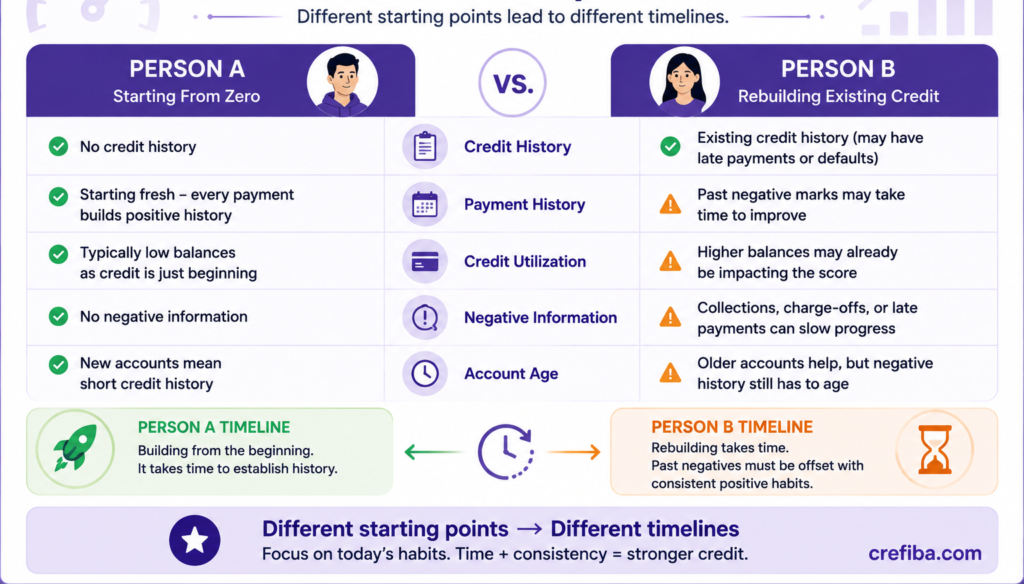
Your starting point matters.
Someone Starting With No Credit
A person with no previous credit history is building a credit profile from the ground up. They need time to establish accounts, payment history, and account age before their credit profile becomes more established.
Someone With Existing Good Credit
A person who already has several years of positive credit history may see changes differently. For example, paying down a high credit card balance could produce a noticeable improvement because the rest of their credit profile is already established.
Someone Rebuilding Poor Credit
A person with late payments, collections, or other negative information may see slower progress. Even after they start making on-time payments, older negative information can continue to affect their credit profile.
Credit Utilization Can Also Change Results
Consider two people who each pay down a $1,000 credit card balance:
- Person A: $1,000 balance on a $2,000 limit → 50% utilization
- Person B: $1,000 balance on a $10,000 limit → 10% utilization
The same dollar payment doesn’t have the same meaning because their overall credit utilization is different.
Different Credit Reports Can Also Show Different Information
Creditors don’t necessarily report to all three major credit bureaus at exactly the same time, and the information appearing on one report may differ from another.
That’s why someone might see a different score depending on which scoring model and credit report are being used.
There is no universal “30 points for this action” rule. Your credit score responds to changes within the context of your entire credit profile.
This is also why comparing your progress with someone else’s can be misleading. Focus on improving the factors you can control rather than expecting your score to move at the same speed as someone else’s.
What Can Slow Down Your Credit-Building Progress?
Building credit is gradual, but certain mistakes can make the process slower or cause your progress to move backward. Knowing what to avoid is just as important as knowing what to do.
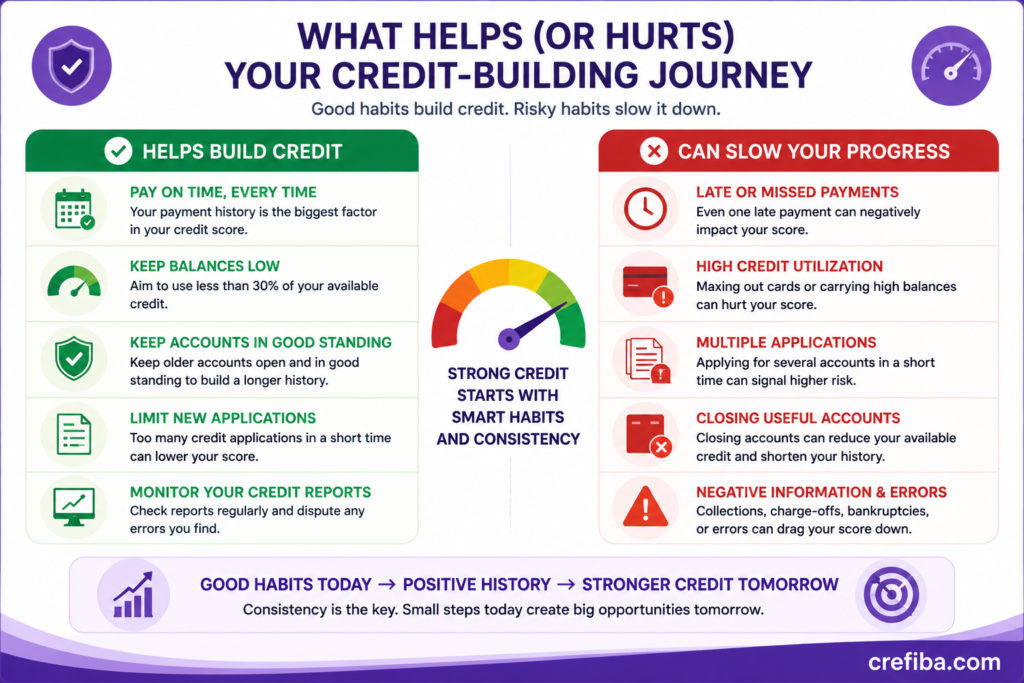
Missing or Paying Bills Late
Payment history is the largest component of a typical FICO Score, accounting for 35%. A missed payment can hurt your score and make it harder to build a strong payment record.
Best approach: Set up automatic payments for at least the minimum amount due, then pay the remaining balance according to your budget.
Keeping Credit Card Balances Too High
High credit utilization can make your profile appear riskier. Because Amounts Owed accounts for about 30% of a typical FICO Score, consistently high card balances can work against you.
If possible, pay down balances and avoid regularly using most of your available credit.
Applying for Too Much Credit at Once
Opening several accounts or submitting multiple applications in a short period can result in multiple hard inquiries and several new accounts.
This can be particularly noticeable when you have a short credit history.
Closing Useful Older Accounts
Closing an older credit card isn’t automatically harmful, but it can reduce your available credit and may affect your credit profile over time. If an older account has no annual fee and is manageable, there may be a benefit to keeping it open.
Having Accounts That Don’t Report
Responsible activity generally needs to be reported to the credit bureaus to become part of your credit history. Before opening an account specifically to build credit, check whether the issuer reports to the major credit bureaus.
Expecting Immediate Results
One of the biggest mistakes is assuming that every good financial decision will produce an instant score increase.
Some changes can show up relatively quickly, while others require months or years of consistent history.
The best way to build credit isn’t to constantly chase your score. It’s to avoid new negative information while consistently creating positive credit history.
If you’re already following good habits but your score isn’t moving as expected, the next step is to look at what is actually being reported on your credit reports rather than simply opening another account.
What If You Need to Build Credit Quickly?
Sometimes you don’t have the luxury of waiting years to establish a credit history. You may need credit for an apartment, car loan, credit card, or another major financial decision.
The important thing is to avoid rushing into actions that could hurt your credit just because you need a score quickly.
If You Need Credit for an Apartment
Ask the landlord or property manager which credit requirements they use. Some may consider your credit score along with your income, rental history, employment, and other factors.
If you have little or no credit, having proof of reliable income and a strong rental history may be useful.
If You Need an Auto Loan
If you’re planning to finance a car, avoid opening several new credit accounts immediately beforehand. Instead, review your credit reports, check your current score, and compare lenders carefully.
When shopping for certain types of loans, such as auto loans, multiple inquiries made within a defined period may be treated as a single inquiry by some FICO scoring models.
If You Need a Credit Card
If you have little or no credit history, a secured credit card may be an option if you’re eligible. Before applying, check that the issuer reports the account to the major credit bureaus.
Don’t apply for several cards at once simply because you’re trying to establish credit faster.
If You Need a Mortgage
This is where planning ahead matters most.
If you’re hoping to buy a home, start reviewing your credit well before you apply. That gives you time to correct errors, reduce high balances, and establish consistent payment history without making rushed decisions.
The Best “Fast” Strategy
If you need to build credit quickly, focus on the things that are actually within your control:
- Make every payment on time.
- Keep credit card utilization low.
- Avoid unnecessary applications.
- Check your credit reports for errors.
- Use accounts that actually report your activity.
- Give positive information time to accumulate.
There is no legitimate way to create years of credit history overnight. If you need credit soon, the smartest approach is to strengthen the information already on your credit reports rather than taking on unnecessary debt.
This is an important distinction for readers: building credit quickly means making the next few months count—not trying to manufacture a long credit history in a few weeks.
Credit-Building Timeline: 30 Days, 6 Months, 1 Year and Beyond
There is no universal deadline for building credit, but looking at the process in stages can make the timeline easier to understand. These milestones are general guidelines, not guaranteed score increases.
| Timeline | What You Should Focus On | What May Happen |
|---|---|---|
| First 30 days | Open a reporting account, set up payments, keep balances low | Your account may begin appearing on your credit reports |
| 1–3 months | Make every payment on time and avoid unnecessary applications | Positive payment information begins accumulating |
| Around 6 months | Continue consistent credit management | You may become eligible for a FICO® Score if its scoring requirements are met |
| 6–12 months | Maintain low utilization and build more payment history | Your credit profile becomes more established |
| 1–2 years | Keep older accounts in good standing and avoid new negative information | Your credit history has more depth and consistency |
| Beyond 2 years | Continue responsible credit management | Account age and a longer positive history can strengthen your profile over time |
The important thing to remember
Your credit score isn’t designed to reward you for reaching a particular number of months. It evaluates the information currently contained in your credit reports.
For example, someone with six months of perfectly managed credit may have a score, but someone with several years of on-time payments and low utilization generally has a much more established credit history.
And if you’re rebuilding after negative credit events, your timeline may look completely different.
So instead of asking:
“How many months until I have good credit?”
A better question is:
“What can I do this month that will make my credit profile stronger six months from now?”
That mindset keeps the focus on the actions you can control while giving your credit history time to develop.
Frequently Asked Questions About Building Credit
How long does it take to build credit from scratch?
If you’re starting with no credit history, you can begin building credit as soon as you open a credit account that reports your activity. A FICO® Score may become possible after about six months if you meet FICO’s scoring requirements, but building a strong credit profile generally takes longer.
Can you build credit in 30 days?
You can start building credit in 30 days, but you generally can’t create a long credit history that quickly. Opening a reporting account, making payments on time, and keeping balances low can establish the right foundation for future improvement.
How long does it take to get a 700 credit score?
There is no fixed timeline for reaching a 700 score. Someone with no credit history may take considerably longer than someone who already has an established profile. Your payment history, utilization, account age, and negative information all affect the timeline.
How long does it take to build good credit?
There is no guaranteed number of months. You may establish a score within several months, but reaching and maintaining good credit generally requires consistent responsible credit management over a longer period.
Can I build credit without a credit card?
Yes. Certain installment loans and other credit accounts can contribute to your credit history. However, you should never take on debt you don’t need solely to build credit. A secured credit card can also be an option for people who need to establish or rebuild credit.
How long does it take to rebuild bad credit?
It depends on what’s causing the problem. High credit utilization may improve relatively quickly after balances are reduced and reported. Negative information such as late payments can take much longer to recover from, although its impact may decrease as it ages and you establish a stronger payment history.
Does checking my credit score hurt my credit?
Several factors could be responsible, including high utilization, a short credit history, recent applications, negative information, or simply not enough new information being reported yet.
If you’re making responsible payments but aren’t seeing progress, don’t assume you need another credit account. First, review your credit reports and identify what is actually affecting your score.
One thing to remember
Building credit is a process, not a deadline. You can take positive steps today, but some parts of your credit profile—especially account age and length of credit history—can only improve with time.
Key Takeaway: Building Credit Is a Long-Term Process
You can start building credit today, but there is no shortcut to creating a long, established credit history.
If you’re starting from scratch, your first credit score may become available within several months, while building a strong credit profile can take a year or longer. If you’re rebuilding damaged credit, your timeline depends on what is affecting your credit and how consistently you address it.
The most important things you can control are simple:
- Pay every bill on time.
- Keep credit card balances low.
- Avoid unnecessary credit applications.
- Check your credit reports for errors.
- Keep well-managed accounts in good standing.
- Give your positive credit history time to grow.
Don’t get discouraged if your score doesn’t change immediately. Some improvements can happen relatively quickly, while factors such as account age and length of credit history naturally require more time.
Remember:
You don’t build strong credit by rushing the process. You build it by making responsible credit decisions consistently and giving those decisions time to add up.
If you’re starting with no credit, focus on establishing a clean credit history first. If you’re rebuilding poor credit, focus on stopping new negative information and strengthening your existing profile.
The timeline may be different for everyone, but the basic principle remains the same: good credit is built one responsible decision at a time.
If you’re working on building or improving your credit, these Crefiba guides can help:
- How Long Does It Take to Build Credit? A Realistic U.S. Timeline
- How to Pay Off Credit Card Debt Fast: A Strategic 2026 U.S. Guide That Actually Works
- What Is APR on a Credit Card? U.S. Guide Every Cardholder Must Understand in 2026
- Is a 900 Credit Score Possible? (2026) The Real Answer
- Bilt 2.0 Credit Card Explained: 5 Things That You Must Know 2026

The Crefiba Research Team creates easy-to-understand, accurate, and practical content on credit, personal finance, and banking in the United States. Our articles are carefully researched using trusted sources such as Experian, Equifax, TransUnion, and U.S. financial institutions, and are written to help everyday people make smarter financial decisions.
Learn more: About Crefiba • Editorial Standards